
What Carter County Deeds Record
The Carter County Clerk records the instruments that touch land: deeds, correction deeds, easements, leases, restrictions, affidavits, plats, mortgages, assignments, and releases. An index entry is only a pointer. It tells you where an instrument sits, not what it says. The full image carries the legal description, consideration statement, source of title, signatures, notarization, and the exceptions. Those exceptions make a Carter County transfer genuinely understandable.
| Deed Type | What It Does | Common Use |
|---|---|---|
| General deed | Transfers the stated interest and identifies both parties | Sale or other conveyance |
| Correction deed | Corrects the earlier instrument without changing ownership | Name, description, or drafting correction |
| Executor or fiduciary deed | Conveys through an estate representative | Estate administration |
| Deed with nominal consideration | Records a gift or low-consideration transfer with a sworn certificate | Family or estate planning transfer |
| Tax-related instrument | Documents an interest arising from delinquent-tax proceedings | Certificate or later tax-sale research |
A mortgage is not a deed. It secures a debt against the property. A release can clear all or part of that recorded claim, so read these linked instruments alongside the conveyance when evaluating a Carter County chain of title.
Carter County eCCLIX Access
The Carter County Clerk online-records page routes visitors to eCCLIX, the internet counterpart to CCLIX. Carter residents get a free account. It covers personal, noncommercial use and allows five searches each day. Commercial research requires a subscription. A subscription can add records from other participating counties as well. The page itself shows no live deed search fields. No date cutoff, image gate, result limit, sorting, or export controls appear on it either. Treat eCCLIX as broad, not complete. Before calling or visiting the deed room, write down the party name, any document clue, a legal-description term, and a book and page reference. Note: Five daily resident searches reward careful spelling and a focused list of likely grantor and grantee names.
Carter's 1838 Deed Trail
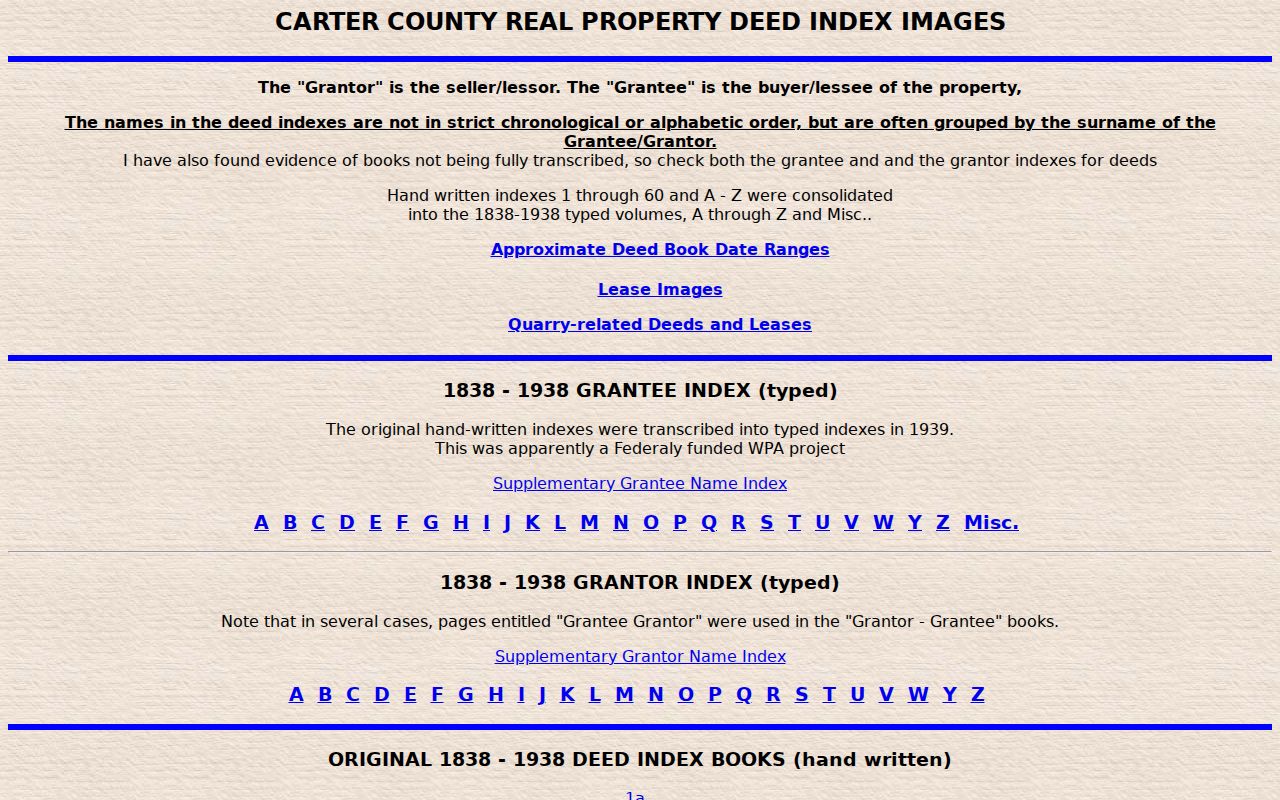
Serious Carter County deed records work often starts away from the modern portal. The Carter deed-index finding aid points to handwritten volumes. These sit alongside WPA-typed grantor and grantee books spanning 1838 through 1938. Later handwritten image books carry the run through 2007. The typed versions date to 1939. A transcription slip or an odd name grouping can hide a deed. The original record still shows it clearly.
Expect imperfect order. Names drift in and out of alphabetical and date sequence across these index books. Search each surname as both grantor and grantee, and try initials along with spelling variants. Inspect neighboring name groups too. Older rural tracts tell a different story. The trail may run through a creek, an acreage figure, or an adjoining owner. It may pass to a railroad, the school board, or a road reference rather than any modern street address.
The structure is visible in the historic Carter County deed index.
Trace Carter County Deed Chains
A chain of title links every conveyance for one piece of land. Together, they form a single sequence. In Carter County deed research, you work backward from the newest reliable conveyance. Do not start from a loose surname match. Keep the legal description next to the names at each step. The same person often held several Carter County parcels. So names alone cannot carry the chain.
- Start with the present owner as grantee on the deed by which that owner acquired the property.
- Read the grantor, source-of-title citation, legal description, and book/page from the full deed.
- Search that grantor as an earlier grantee, then compare the land description before accepting the match.
- Repeat through eCCLIX or the historic index, moving to deed books, archives, or staff help where online coverage ends.
- Grantor
- The party transferring an interest, often the seller.
- Grantee
- The party receiving an interest, often the buyer.
- Book and page
- The clerk's physical or image-volume location for an instrument.
- Chain of title
- The connected set of transfers for the same land.
Read Carter County Land Clues
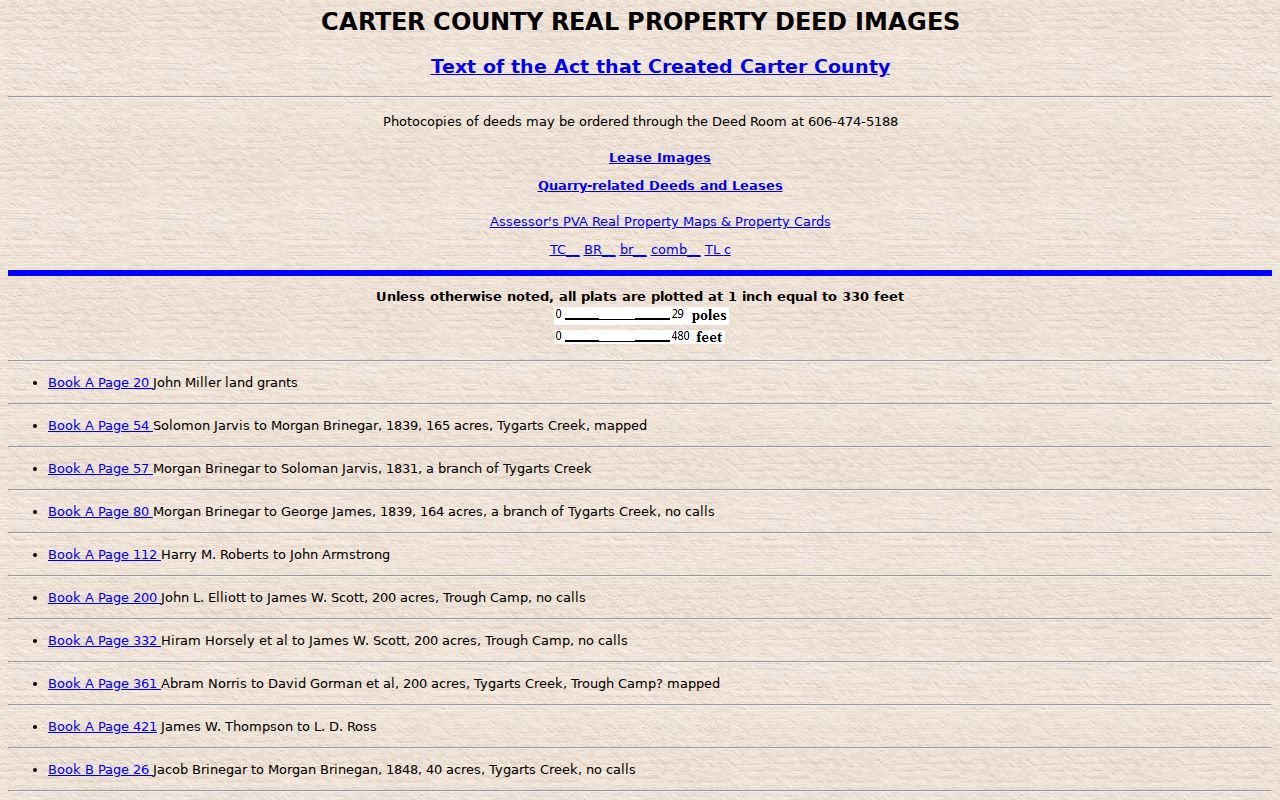
Carter's historic deeds prove that a name by itself proves little. Book A page 54 records an 1839 transfer of 165 acres on Tygarts Creek. Book 188 page 724 pins down College Hill Subdivision Lot 13. Later entries bring in C&O rights-of-way and school property. Highways appear too. A City of Olive Hill acquisition rounds out the mix.
Two reading habits fit this mix. For older rural land, follow watercourse, acreage, adjoining-owner, and parent-tract language. For town lots and later development, track subdivision, lot, block, and plat wording. Road and right-of-way language matters too. The historic deed-image page gives book-and-page examples. It also offers deed-room ordering guidance for Carter County deed records researchers.
Examples of the book/page route appear on the Carter historic deed page.
Note: An index description may omit the exact date or consideration, so check every clue against the linked deed image.
Carter Deed Filing Requirements
A Carter County deed has to carry several items before the clerk will record it. The clerk's recording rules lay out the list. The deed must name the grantor and grantee with mailing addresses. It also states the consideration under KRS 382.135, gives the legal description, and cites the source of title. A preparation statement under KRS 382.335(1), a return address, and notarized signatures complete the package.
Carter County Recording Costs
Fees change, so confirm the current schedule before submitting anything. The published list prices a standard deed at $50. A correction deed runs $46. Releases and assignments commonly cost $46. Easements, leases, restrictions, and similar instruments are often $50. A mortgage is $80 for up to thirty pages. A mortgage with an assignment or MERS runs $126 at that page count.
Carter Deed Alert Fields
The county also offers a Doc Alert signup for deed records. It is not a title search. It does not block any filing. What it does is send notice when a deed or mortgage is recorded under a subscribed person or business name. That gives an early signal that an unfamiliar instrument has hit the record.
Note: Register every relevant spelling variant the service allows. Then verify any notice against the actual clerk record.
| Signup field | Purpose |
|---|---|
| Business or Trust | Switches from a personal-name registration |
| County and Confirm County | Checks the Carter County selection |
| First, middle, last, suffix | Builds the monitored personal name |
| Email and Confirm Email | Sets and verifies the notice address |
Note: Register every relevant spelling variant the service allows, then verify any notice against the actual clerk record.
Obtain a Carter County Deed
Start with the online image whenever the deed you need is available there. If it is not, visit the Carter County Clerk Deed Room at 300 W Main Street in Grayson. You can also call (606) 474-5188. A second county-clerk counter operates at the Olive Hill branch, 215 W Tom T. Hall Boulevard. Staff can often run the search at a public terminal. Bring names, an approximate date, and a book/page reference if you have one.
Older volumes sometimes sit in off-site storage. The Kentucky Department for Libraries and Archives request service can help there. It researches deeds and other county records. Fees start at a nonrefundable $20 in-state or $25 out-of-state for a search and copies. Extra scan or photocopy charges plus postage may apply. Expect about four to six weeks. The Carter County Public Library is another path, with genealogy, newspaper, land-grant, and family-history collections.
Recorded, not guaranteed. A Carter County deed index shows filed instruments, not a title opinion. Unrecorded interests, defects, and later claims may require professional title work.
Kentucky's Open Records Act offers one more route. It applies when identifiable public material is not exposed through an index. Send the request to whichever office holds the deed record. Describe the instrument, the parties, approximate dates, and your preferred format. KRS 61.880 gives the agency five working days to respond. Exemptions apply, along with any stated reason for delay or denial. Inspecting a record is different from ordering copies. Confirm local copy and certification charges with the Carter custodian first.
Carter Deed Requests Need Exact Clues
An online search that comes up empty should turn into a focused counter request. Give the Carter County Clerk a grantor or grantee name. Add an approximate recording year, the instrument type, and any book/page or legal-description clue. Check both party roles. A buyer appears as grantee and may later leave the chain of title as grantor. For a subdivision parcel, include the lot, block, and plat name. For rural acreage, keep creek, road, adjoining-owner, railroad, school, and parent-tract references. Those details help staff separate similar names and pull volumes that are not exposed online.
Be clear about what you need. It may be an index entry, an ordinary image, or a certified copy. Recording charges on the clerk's fee page do not automatically price an existing copy. The schedule also varies by document type and page count. Confirm the current amount before paying. If a historic volume has moved off-site, request the named series through KDLA. The Carter County Public Library can supply supporting clues. The Morehead State genealogy collection adds land, newspaper, cemetery, and family-history material.