
Build the Carter County Former-Owner Timeline
Every backward chain starts at the most recent confirmed transfer. Anchor the whole project to a single tract using its legal description, a source-of-title recital, a parcel clue, acreage, lot and block, or a book and page citation drawn from the property records.
| Transfer date | Grantor to grantee | Deed type | Book/page |
|---|---|---|---|
| Newest match | Previous owner to current grantee | Warranty, quitclaim, or fiduciary | Current reference |
| Earlier acquisition | Earlier owner to prior owner | Matching conveyance | Prior reference |
| Parent tract stage | Parent owner to first lot owner | Deed and plat | Older citation |
Treat the timeline as a worksheet, never as a claim about a parcel. Fill it only from Carter records, preserving exact roles, spellings, dates, and legal descriptions.
Walk Carter County's Deed Chain in Reverse
Use the Carter Clerk online-records route and the historic index as separate access points.
- Obtain the newest deed and mark grantor, grantee, type, date, and description.
- Search that grantor as an earlier grantee.
- Open the candidate acquisition deed and match the land.
- Repeat, recording every citation and name variant.
- When no clean deed appears, test probate, partition, affidavit, court, school, railroad, or municipal records.
The vocabulary is simple. A grantor conveys and a grantee receives, while a reverse index organizes entries by grantee. The chain of title links successive transfers, and warranty and quitclaim deeds carry very different promises.
Carter County Prior Owners Reach to the 1838 Formation Era
The Carter deed-index finding aid reaches from 1838 through 2007 in grouped runs. That opening year marks the county's formation from Greenup and Lawrence. Land recorded earlier may sit in those parent counties. Later boundary shifts can point toward Boyd or Elliott.
Carter publishes no official cutoff date for the eCCLIX system. The online record can thin out. The trail continues through the Deed Room, deed books, microfilm, the library, and the Kentucky Department for Libraries and Archives.
Coverage warning. The historic finding aid begins in 1838, but eCCLIX has no verified published cutoff. Older previous owners may require physical volumes or archive help.
The 1939 WPA Index Changes Carter Name Searches
Carter's grantor and grantee volumes covering 1838 through 1938 were typed in 1939, apparently as a WPA project. Handwritten image runs carry the record onward through 2007. Transcription can preserve an old spelling or introduce a new error.
Entries do not follow the clean alphabetical or chronological order a modern searcher expects. Try name variants. Check both party roles. Scan the neighboring groups. A missing spelling never proves a former owner is absent from the property records.
The historic Carter deed-index source shows how these grouped volumes are laid out.
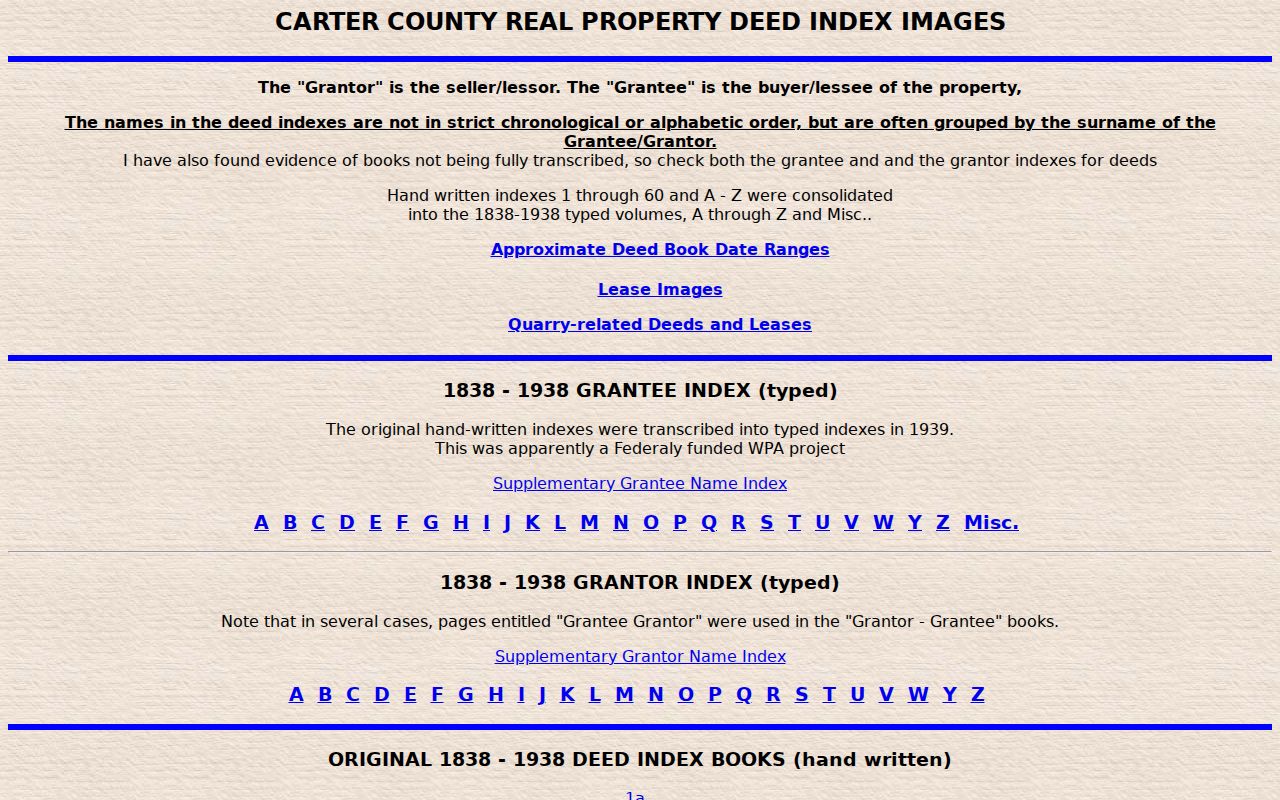
The grouped volumes show why those details matter: volume, party role, spelling, and image group all belong in the chain worksheet.
Note: An index is a pointer; verify the deed image for parties, consideration, legal description, restrictions, and the recording reference.
Follow Carter County Creeks and Rights-of-Way
Older rural deeds often carry no modern street address. Carter examples include an 1839 tract of 165 acres on Tygarts Creek. Another deed lists 164 acres at a branch. Search creek name, acreage, adjoining owners, and book and page together.
Other Carter deeds name C&O rights-of-way. Some name the Board of Education, KY 1626 near Soldier, or a City of Olive Hill grantee. These parties explain tract splits. They also mark the shift from family ownership to road, school, railroad, or municipal use.
Move Carter County Former Owners From Tract to Lot
Subdivision chains usually shift language from acreage to lot, block, plat, and road. College Hill Subdivision Lot 13 sits at Book 188, page 724. That citation opens the work on the lot. It does not date the whole subdivision.
PVA map sheets supply discovery labels for a Carter County property search. Olive Hill sheets name Blueberry Ridge, Depot, Eastland Avenue, and US 60. Grayson sheets name AA Highway, I-64, Everman's Creek, and Four Mile. Confirm every label against the legal description. Also check the recorded plat.
Repair a Carter County Chain Broken by an Estate
A prior owner can vanish from a tidy sequence. The reason is often the land itself: it passed through a will, probate order, affidavit of descent, fiduciary deed, partition, quiet-title case, or foreclosure. Search the decedent and the fiduciary. Then carry the heirs or grantees back into the deed index.
CourtNet lists current cases and parties, but the Carter clerk holds the actual file. Historic judicial indexes and newspaper notices may explain a transition. Neither substitutes for a matching land description in the deed records.
Continue Carter County Ownership History Offline
The Deed Room at 300 W Main Street in Grayson works from a party name, a year range, and a citation. Call (606) 474-5188. The Olive Hill branch offers another counter. The Carter County Public Library provides computers, copying, and local-history help. Morehead State holds Carter newspapers, cemetery items, deeds, grants, and family histories.
KDLA accepts requests for historic county record groups. A narrow Kentucky Open Records Act request can surface non-indexed public material. Send the tract clue, name variants, dates, and any known references.
Limits of a Carter County Former-Owner Chain
A research worksheet is not a certified abstract or a title opinion. A finding aid may omit an image. A name may be misread. An unrecorded interest will never appear. Verify every link against the original deed.
Newspapers and family sources can explain an old road, business, place, or surname. Keep them as context. The deed and its legal description remain the parcel evidence. Carter was formed from Greenup and Lawrence Counties. Parts of it later helped form Boyd and Elliott. This means a chain near an old line may change county names without changing the family tract. Add the parent county, the creek or road, the place name, the party role, and later county-line context to the worksheet. The Kentucky Department for Libraries and Archives formation chart can orient that wider search. The original volume must still confirm each transfer. This method keeps former owners tied to evidence. It avoids forcing modern county labels onto older land.
Bridge Gaps in Carter Ownership History
A gap in the deed records rarely means the chain is broken. Land in Carter County often moved without an ordinary sale. An executor's deed, a will, a partition action, a quiet-title judgment, or an affidavit of descent can carry title forward. Tax certificates, correction deeds, and municipal acquisitions do the same. Search the former owner in both the grantor and grantee columns of the deed index. Then chase the estate, spouse, trustee, company, school board, railroad, or city named in the neighboring entries. The index may give only a party or a filing clue. CourtNet and the Carter Circuit and District Clerk can clarify a judicial transfer.
Geography can redirect the whole search. Carter County formed in 1838 from Greenup and Lawrence. An early parcel trail may start in a parent county's deed books. Later boundary changes can push a search toward Boyd or Elliott. Rural deeds often follow Tygarts Creek, a branch, acreage figures, adjoining owners, or a right-of-way instead of a street address. Town chains may hinge on a subdivision plat, a lot and block number, or a renamed road.
Keep an evidence log instead of forcing one seamless story. For every candidate transfer, record the date, grantor, grantee, and deed type. Add the book and page, the description match, and any open question. Separate what the index shows from what the instrument itself says. That habit exposes gaps and keeps two same-named parties from merging into one. It also gives deed-room or archive staff a precise request.
Carter Archives Extend the Chain
When a historic deed book is not online, ask where it lives now. It may sit in the deed room, survive on microfilm, or rest in state custody. A KDLA request should name Carter County, the series, the party, and the year. It should include the citation too. Library newspapers, cemetery files, and family collections can hint at a name change. They may also point to an estate. They stay leads until a deed, probate record, or judgment confirms the land event. Plan the search around archive fees and the stated four-to-six-week response estimate.